
Protein Engineering
Protein Engineering to Increase Direct Electron Transfer in Formaldehyde Dehydrogenases
Dirk Holtmanna and Anna-Lena Drommershausena
a Karlsruher Institut für Technologie (KIT), Karlsruhe, Germany; Group Website
Introduction and Background
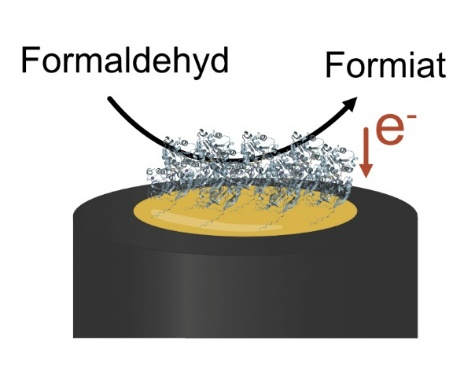
The conversion of CO2 into valuable raw materials like methanol is an important pillar for a sustainable economy, with the enzyme formaldehyde dehydrogenase (FaldDH) often playing a key role. The enzyme reversibly catalyzes the conversion of formaldehyde to formate. In nature, however, this enzyme requires a very expensive "helper substance" (the cofactor NADH), which has made its industrial application uneconomical so far. To solve this problem, researchers at the Karlsruhe Institute of Technology (KIT) investigated a way to feed the required redox equivalents directly into the enzyme without any detours—a process known as direct electron transfer (DET). Since enzymes are generally poor at accepting current directly from an electrode, the scientists used a trick from protein engineering: they coupled the enzyme with a biological "relay," cytochrome b562, which passes on the electrons like a small temporary storage unit. For this connection, various "spacers" (protein linkers) were tested: on the one hand, rigid, rather immobile connections, and on the other hand, very flexible, mobile chains. To find out which combination works best, the modified enzymes were applied to gold electrodes and examined using high-precision measuring devices, such as a Gamry potentiostat. These devices make it possible to precisely control and measure the current while the enzyme can be studied in a defined environment.
Experiment
For the study, various fusion proteins were molecularly constructed in which the cytochrome b562 was connected to the FaldDH via different linker morphologies. The electrochemical characterization was performed using a Gamry 1010B potentiostat and an IMX8 multiplexer using the Gamry Framework software. The characterization took place in a three-electrode arrangement. Gold electrodes with an area of 0.02 mm² served as the working electrode, which were polished with fine-grained sandpaper before each experiment to ensure reproducible surface conditions. A platinum wire was used as the counter electrode, while a silver/silver chloride (Ag/AgCl) electrode was used as the reference electrode.
Specific measurement parameters were selected for cyclic voltammetry (CV) to investigate the electron transfer in detail (Figure 2). The potential range extended from -200 mV to +400 mV versus the Ag/AgCl reference electrode, and the scan rate was 10 mV/s with a step size of 5 mV. Additionally, the Surface Sampling Mode of the Gamry software was used to average the current over the entire duration of a potential step and the maximal current was set to 0.01 mA in fixed mode.
This allowed both capacitive effects and surface-bound Faraday reactions to be precisely recorded; all measurements were carried out under controlled conditions. For this purpose, a 100 mM phosphate buffer with a pH of 7.0 was used, which was previously purged with nitrogen (N2) to ensure an oxygen-free environment.
Results
The investigations showed clear differences depending on the type of linker used. It was found that rigid linkers tended to impair the ability for direct electron transfer, while flexible linkers showed significantly better results. A particularly high-performance increase was observed for a variant featuring a linker of 20 amino acids. This variant showed the greatest increase in current density and achieved a 1.6-fold increase in current density at a potential of +400 mV versus Ag/AgCl compared to the wild-type enzyme (Figure 2).
During the measurements, however, undesired interference effects were also identified; it was shown that formaldehyde reacts with basic amino acids such as lysine on the protein surface, which led to distorted electrochemical signals. To account for these side reactions, a correction method was developed involving the normalization of the measurement data based on the accessible surface area of the basic amino acids. In this way, the purely catalytic currents could be reliably separated from the interfering contributions. Through the developed evaluation strategy, it was possible to computationally eliminate these influences and precisely determine the actual catalytic current flow.
Overall, the results illustrate that the choice of the linker has a decisive influence on the efficiency of the electron transfer. While rigid connections limit the current flow, a long, flexible structure enables a significant increase in performance. The achieved 1.6-fold increase in current density compared to the wild-type enzyme represents significant progress and underscores the potential of this approach for the development of efficient cofactor-free biocatalysis. Furthermore, these findings open new perspectives for applications in CO2 reduction as well as in the development of high-performance biosensors.
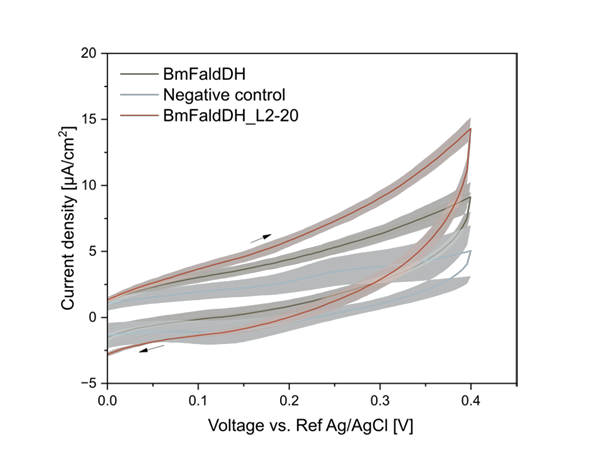
Figure 2. Electrochemical characterization of BmFaldDH, non-non coated electrode (negative control) and the BmFaldDH fusion protein with the 20 amino acid linker (BmFaldDH_L2-20). Cyclic voltammograms displayed as average current densities [μA/cm2] plotted against voltage vs. Ag/AgCl reference electrode [V] for selected enzyme variants at a formaldehyde concentration of 20 mM.
Acknowledgements
C3 Prozess- und Analysentechnik GmbH (Haar, Germany) for allowing us to share this content. Special thanks to Dr. Dirk Bublitz and Dr. Christian Schrader.
https://c3-analysentechnik.de/en/
Application Note Protein Engineering to Increase Direct Electron Transfer in Formaldehyde Dehydrogenases Rev. 1.0. 5/13/2026.  Copyright 2026 C3 Prozess- und Analysentechnik GmbH. Interface and Framework are trademarks of Gamry Instruments, Inc.
Want a PDF version of this application note?
Please complete the following form and we will email a link to your inbox!
Categories