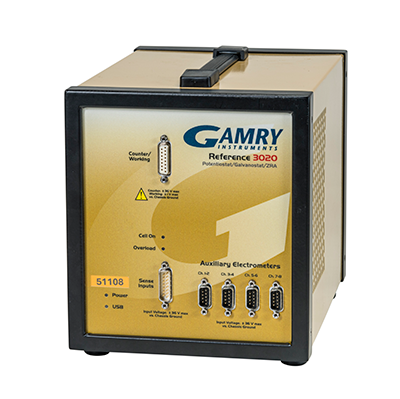
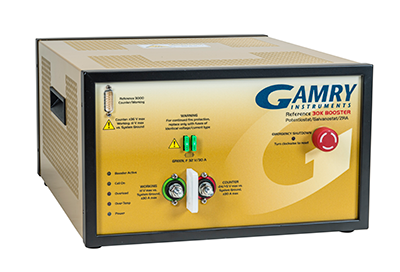
It’s been a very productive winter here at Gamry. The release of the Reference 3020 potentiostat has taken everything we’ve learned and improved upon in the Reference 620 potentiostat for ultra-high impedance measurements and made it available for ultra-low impedance measurements. Why does it make sense to compare the two extremes of the impedance spectrum? They’re two sides to the same coin as far as instrumentation is concerned. And in the case of the Reference 3020, it can do both ultra-low and ultra-high impedance. That’s why it’s our flagship model. You can never go wrong by picking one up for your electrochemistry needs. We’ve got more to come this year. Follow us on LinkedIn to stay current with the latest from Gamry.
NEW EIS Short Course—We’re finally kicking off our first EIS course based in Gamry’s EU Office to better serve our global EIS community! Join us for an intensive week-long hands-on course. We don’t just teach you “how to” run EIS. We teach you why and when you should run EIS. And perhaps most importantly, how to identify quality impedance data from those compromised by systematic error. Scroll down for more details.
Corrosion, Corrosion, Corrosion!—The Khonsari Group at Louisiana State University has graciously provided the Gamry community with insights into how entropy can be used to quantify electrochemical corrosion rates. It’s a unique way to think about corrosion and may be useful as a complement to standard LPR and EIS methods. The timing coincides nicely with our annual announcement of The Ohio State University short course on Corrosion: Fundamentals and Experimental Methods. Scroll down to get a copy of the full application note and to register for this year’s corrosion short course.
Mastering Electrochemical Impedance Spectroscopy A 4 Day Intensive Workshop 22 – 26 June Via G. Amendola 1 27058 Voghera (PV) Italy
Over four days, you will start with the fundamentals of EIS and fitting software (Day 1), then explore batteries and practical battery measurements (Day 2), followed by corrosion mechanisms and impedance experiments (Day 3), and conclude with porous electrode modeling and an interactive roundtable/Q&A session (Day 4).
Thermodynamics of Corrosion: Degradation Entropy Generation
Written by Lijesh Koottaparambil and Michael M. Khonsari Department of Mechanical and Industrial Engineering, Louisiana State University, Baton Rouge, Louisiana 70803, USA
Electrochemical techniques are extensively employed for corrosion characterization owing to their ability to provide time-resolved, quantitative descriptions of interfacial degradation processes at the metal–electrolyte boundary. Conventional corrosion descriptors, including corrosion current density, polarization resistance, and gravimetric mass loss, provide effective means for comparing materials under controlled conditions. However, their dependence on environmental and electrochemical parameters—such as electrolyte composition, temperature, applied potential, and exposed surface area—limits their generalizability
This course is offered in an online format, with live and recorded video lectures and lab demonstrations. The course is taught by Dr. Gerald Frankel, Dr. Jenifer Locke, and Dr. Rudy Buchheit, Dean of the College of Engineering, University of Kentucky.