




Physical Electrochemistry Software is a researcher’s basic electrochemical toolkit. Techniques such as cyclic voltammetry, chronoamperometry, and chronopotentiometry are the foundation for basic research and are necessary in teaching, research, and industry.
Menu
Close
Software
Product Details
Overview
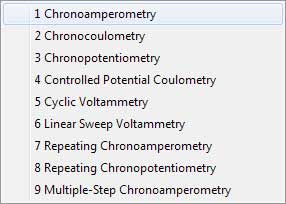
Physical Electrochemistry Software is the starting package for research electrochemistry. It includes necessary tools such as Cyclic Voltammetry, Linear Sweep Voltammety, and various Chrono- techniques.
The experiments available within the Physical Electrochemical Software can be used to determine redox potentials, reaction mechanisms, chemical concentrations, and kinetic rate constants. Industrial applications include batteries, fuel cells, biological electrochemistry, electrolysis, and chemical sensors.
Gamry’s research electrochemistry options start with Physical Electrochemical but also include Pulse Voltammetry, and DigiElch Electrochemical Simulation Software—a powerful research tool, particularly useful for simulation of reaction mechanisms.
Features
The Physical Electrochemical software includes several features that are very helpful for users who need a bit more out of their system:
- Sampling Mode
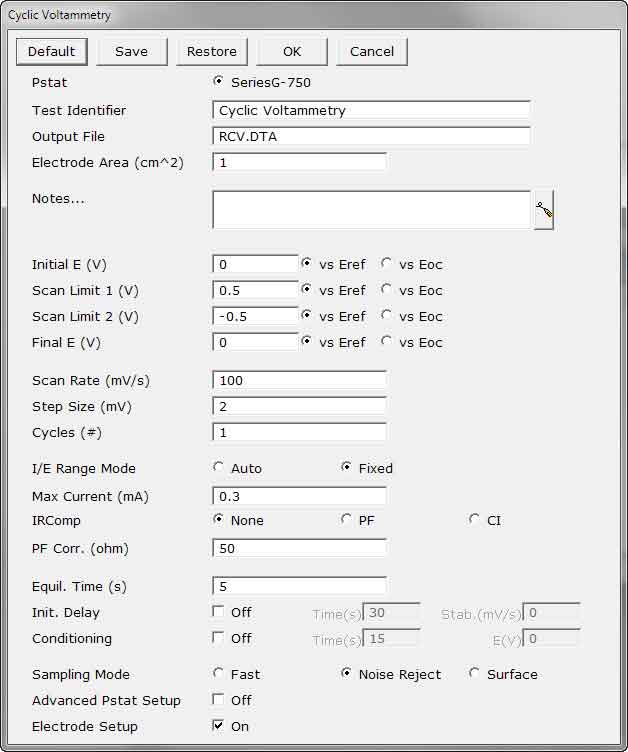
- Gamry adds “Noise Reject” and “Surface Mode” sampling to the digital potentiostat standard (labeled “Fast”). Both modes serve to improve signal to noise over the standard mode, but the Surface mode in particular has allowed Gamry to solve a problem that plagues other digital instruments: measurement of both double layer (capacitor) charging and capturing the electrochemistry of surface bound groups. Conventional (fast) data acquisition only collects data at the end of each digital staircase step. For species that diffuse to the electrode this can actually be an advantage (exclusion of most charging current from the signal).
- Advanced Pstat Setup
- Advanced users who want control over filtering, stability and speed of the system always have it at the script level. In PHE200 these controls are available through the experimental setup window making them easier to implement.
- Electrode Setup
- Users of mercury drop electrodes (DME, SMDE, HMDE), rotating electrodes and/or Stir-Purge units can set up those various devices through this menu.
- Positive Feedback IR Compensation
- Higher acquisition rate experiments cannot operate with current interrupt mode IR compensation. Positive Feedback allows collection of IR compensated data in these experiments. The uncompensated resistance value must be known and constant during an experiment for this to operate properly.
System Requirements
- Gamry Reference or Interface Family Instrument or other USB-based instrument compatible with the Gamry Framework Software
- Microsoft® Windows™ 10(32-bit or 64-bit) Required, Microsoft® Windows™ 11(32-bit or 64-bit) Recommended
- 16 GB RAM Required, 32 GB RAM Recommended
Experiments
There are two general experimental setup types within the Physical Electrochemical software: one for sweep techniques and one for chrono techniques. Users of sweep techniques specify voltage stops (scan limits), scan rate, and step size. Users of time-based techniques specify the voltage or current of the step, the total step duration and the sample period (data acquisition rate).
Cyclic Voltammetry
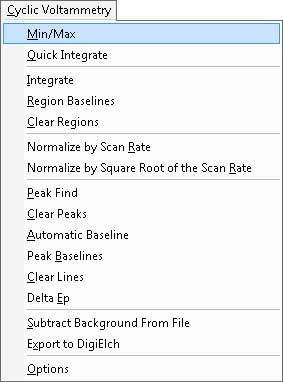
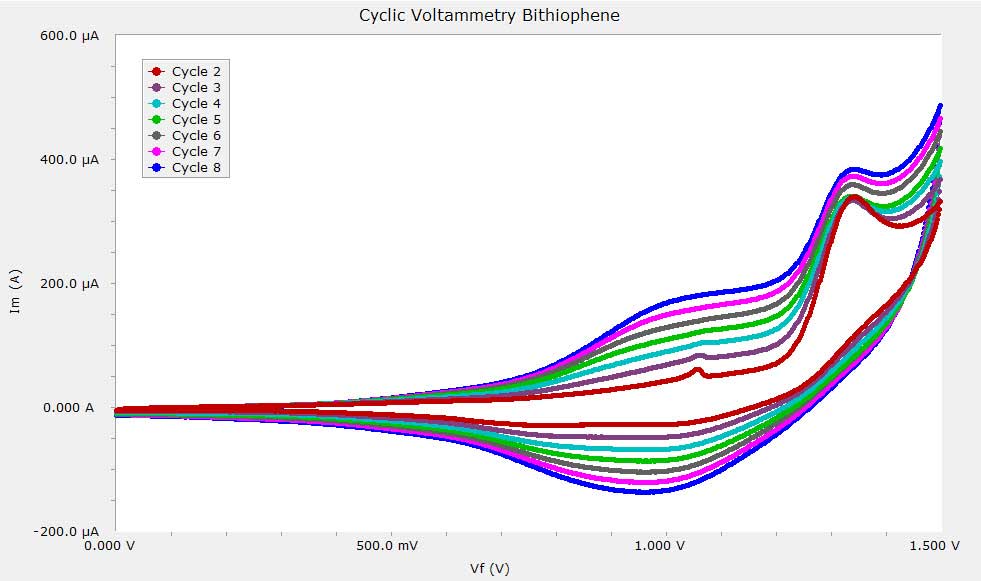
Gamry’s data acquisition and analysis software in the Physical Electrochemical software brings additional flexibility and power to cyclic voltammetry. Any user can run with scan rates from 1 mV/s to 1000 V/s (advanced users can go faster still).
Linear Sweep Voltammetry
Linear sweep voltammetry is best described as the first portion of a cyclic voltammogram. The Linear Sweep Voltammogram appears exactly as the initial portion of a CV from Initial E to Scan Limit 1. Linear Sweep is used primarily for semi-quantitative measurement of electroactive species.
Chronoamperometry
Chronoamperometry is used to study diffusion-controlled electrochemical reactions and complex electrochemical mechanisms. It is generally performed by applying an initial potential at which no faradaic reaction is occurring, then stepping the potential to a value at which the electrochemical reaction of interest takes place. The solution is usually unstirred and the current is measured throughout the experiment. Chronoamperometry is also frequently used for detection of electroactive species. The primary difference in this case is data acquisition, which begins after the initial decay and is kept at a constant rate.
Repeating Chronoamperometry
For applications such as pulse plating, electrochemists often wish to apply a square wave and monitor the current profile during each pulse. This is the purpose of the Repeating Chronoamperometry technique.
Multiple Step Chronoamperometry
The Multiple Step Potentiostatic technique allows the user to apply up to 48 different potentials to the cell and monitor the current profile during each step. It is often used to characterize an electrochemical reaction or an electrode material. Complex pulsed plating techniques have become more common and this experiment fits them quite nicely.
Chronocoulometry
Chronocoulometry is chronoamperometry in which the cell current is integrated to calculate charge. The presentation of the charge allows more convenient access to certain information in the experiment and improves signal-to-noise. Chronocoulometry is particularly useful for studying adsorption processes and other surface-constrained reactions such as modified electrodes.
Chronopotentiometry
Chronopotentiometry is performed by stepping the current from an initial value, typically zero, to some finite value and monitoring the potential versus time. When the initial electroactive species has been depleted, a transition in potential will occur. The transition time is related to several electrochemical parameters through the Sand equation. A “Limit V” feature aborts the experiment if the voltage is exceeded.
Repeating Chronopotentiometry
In Repeating Chronopotentiometry, two current values are alternately applied to the cell and the potential is sampled during each current step.
Controlled Potential Coulometry
Controlled Potential Coulometry is an electrochemical experiment in which an electroactive species is exhaustively oxidized or reduced while measuring and integrating the current. The total coulombs accumulated during the experiment allows the calculation of the number of electrons transferred in the electrochemical reaction or the concentration. Since Controlled Potential Coulometry is essentially a long-term chronocoulometry experiment, it utilizes the chronocoulometry analysis procedures for viewing and manipulating the data.