Overview
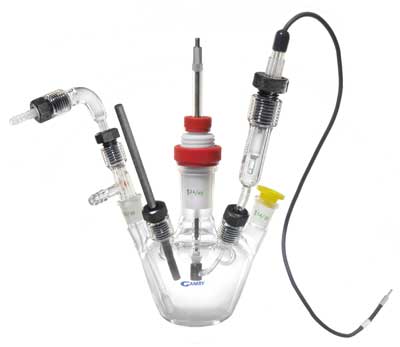
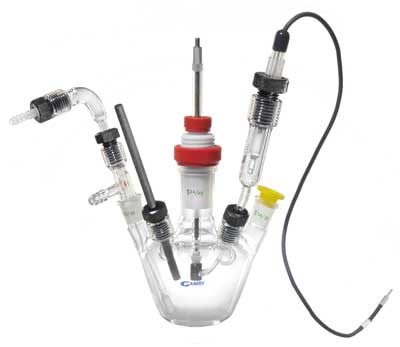
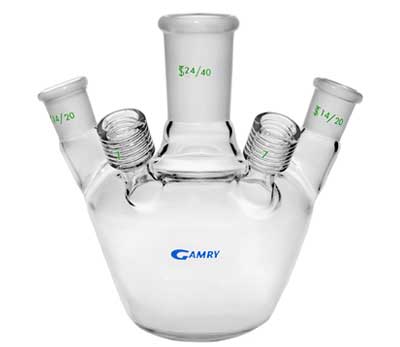
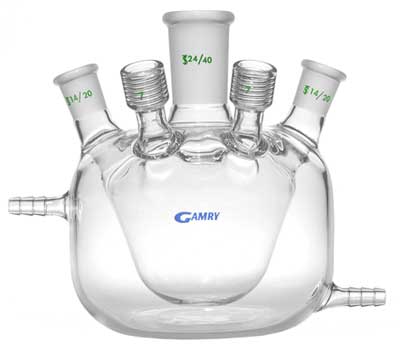
The EuroCell™ operational volume is 50-200 mL. It is equipped with 5 multi-purpose ports. In the normal cell configuration, these ports are used as follows:
- One central 24/40 ground glass joint for a Working Electrode (corrosion sample or rotated electrode—not included)
- One Ace-Thread port for a Luggin capillary/bridge tube for use with Gamry’s SCE, Ag/AgCl, and Hg/Hg2SO4 reference electrodes (electrodes ordered separately)
- One Ace-Thread port for a counter electrode—either a graphite rod or a glass frit isolated platinum wire counter electrode.
- One 14/20 ground glass port for inert gas purging/blanketing (an adapter is supplied)
- One 14/20 ground glass port usable for temperature sensing, reagent addition, gas venting, etc.
The Ace-Threads allow for vertical adjustment to accommodate a wide range of sample volumes. The vertical adjustment is also handy to make sure your reference electrode bridge tube is placed close to the surface of your corrosion sample. The bubbler has one position for deaeration and another for blanketing.
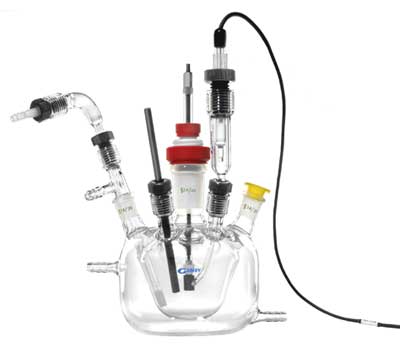
The EuroCell™ is available in a jacketed version for temperature control. The temperature can be controlled by pumping thermostatted water from a water bath through the jacket. Rates of (electro)chemical reactions exhibit strong dependence on temperature.
The standard working electrode assembly used in the EuroCell™ is a shorter version of the one in the MultiPort and is described in ASTM G5 - a cylindrical sample that is drilled-and-tapped with a 3-48 UNC Thread. The working electrode is screwed onto the support rod. A PTFE compression gasket insures a leak-free seal.
Working electrodes for the EuroCell™ can be fabricated in your lab, or purchased in virtually any material from Metal Samples (which specializes in corrosion coupons).
Recommended Uses
Corrosion Testing
Traditionally, corrosion experiments are performed in a one-liter flask such as the MultiPort, using electrolyte volumes of 750-1200 mL. The practice of using large volumes has evolved from standardized procedures such as ASTM G5 for Potentiodynamic Anodic Polarization Measurements. The only technical reason to employ high electrolyte volumes is to minimize contamination by the corrosion products.
Single shot tests (Tafel, potentiodynamic, cyclic polarization) that do not involve leaving the sample in solution for many days (or months in the case of slow corroding materials/environments) work just fine in smaller volumes saving on electrolyte use and disposal.
Non-destructive techniques like EIS, EFM and polarization resistance also work great in the EuroCell™...even long term so long as buildup of corrosion products is not an issue.
Rotated Electrodes
The EuroCell™’s size and shape are well suited to rotated electrode studies. This is particularly true for rotated cylinders which require a deeper cell than either disk or ring-disk.
The jacketing option for the EuroCell™ is another major plus for RRDE work. While electrochemical rates are strongly influenced by temperature, the temperature dependence can become much greater for catalysts and biomolecules.
EuroCell Jacketed Part #990-00203 and Unjacketed Part #990-00196