

Menu
Close
Support
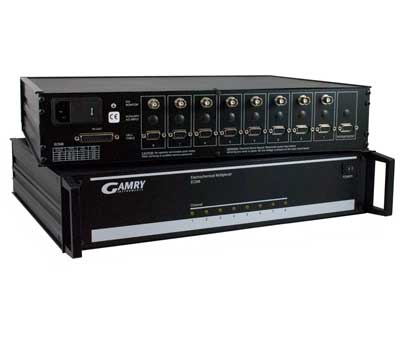
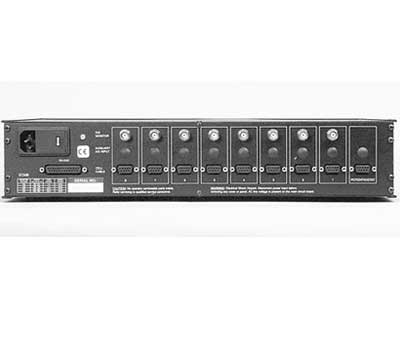
Product Details
The ECM8™ is an affordable way to expand the throughput of your lab. Experiments can be sequentially multiplexed on up to 8 channels. The ECM8™ is ideal for corrosion inhibitor testing, EIS evaluation of paints/coatings, monitoring of field probes for corrosion tests, and chemical sensor development.
Key features include:
- 8-channel for sequential measurements
- DC and AC experiments
- Industry standard multiplexed experiments
Overview
The ECM8™ Electrochemical Multiplexer partners with a Gamry Potentiostat to convert a single potentiostat into a powerful instrument suitable for sequential multichannel operations. It allows you to sequentially take measurements on up to eight electrochemical cells. The ECM8™ Multiplexer is great for automating repetitive experiments, and for increasing throughput on long-term experiments where data can be taken periodically. Each of the eight Multiplexer channels also incorporates a "local" potentiostat to polarize the sample when not participating in the electrochemical experiment. The ECM8™ is not usable for simultaneous multichannel experiments across multiple cells. For simultaneous multichannel experiments see the multichannel potentiostat.
*Note that EIS through the multiplexer is limited to 100 kHz
Applications
- Corrosion Inhibitor Testing
- Paint/Coating Evaluation
- Galvanic Corrosion
- Corrosion Monitoring
- Chemical Sensor Development
Standard Features
- 8-channel for sequential measurements.
- DC and AC experiments.
- Includes industry standard multiplexed experiments.
- 8 Local Potentiostats – Inactive channels can be set to open, short, or polarized.
- Warranty – Protected by 2-year factory service warranty.
Specifications
EIS (Providing Potentiostat is EIS Capable) |
||
| EIS (through the multiplexer) | 10 uHz to 100 kHz | |
CHANNEL CHARACTERISTICS |
||
| Modes | Active, Open, Shorted, Local | |
| Channel Switching Time | <4 msec Excluding communication time |
|
| Cell Current | 1 Amp max Switched | |
| Input Voltage (operating) | ±12 Volts vs. Chassis (except Counter) | |
| Input Voltage (no damage) | ±24 Volts vs. Chassis | |
| Counter Electrode Voltage | ±120 Volts vs. Chassis | |
CHANNEL ISOLATION |
||
| Current Leakage | <2 nA max to any electrode in active channel from any source | |
| Impedance | >500 MΩ <20 pF | |
POWER INPUT |
||
| Input Voltage Ranges | 100,120,220,240 V rms | |
| Allowed Voltage Variation | ±10% on each range | |
| Power | <50 VA | |
LOCAL POTENTIOSTAT
|
||
| Compliance - Current | ±20 mA - 500Ω load | |
| Compliance - Voltage | ±11 Volts - 1kΩ load | |
| Applied E Range | ±5.12 Volts Working vs. Reference | |
| Resolution | >80 dB (10 kHz) >60 dB (1 MHz) |
|
| Zero Offset Error | <4 mV typical 0 Volts output <10 mV max 10 kΩ load |
|
| Gain Error | <0.2% - 10 kΩ load | |
| Reference Input Current | <50 pA | |
| Note: Applied voltage error is the sum of zero offset and gain errors. | ||
RS-232 COMMUNICATIONS |
||
| Baud Rates | 300, 600, 1200, 2400, 4800, 9600, 19200 Set via internal DIP switches |
|
| Default | 9600 - Factory setting | |
| Handshake | Hardware via RTS and CTS | |
ENVIRONMENTAL |
||
| Operating Temperature | 0 to 45° C | |
| Humidity | 0 to 90% - Noncondensing | |
Manuals
Accessories
ECM8 120V Multiplexer for Reference 600+ w/Cell Cables - #992-00130
ECM8 240V Multiplexer for Reference 600+ w/Cell Cables - #992-00131
ECM8 120V Multiplexer for Interface 1000/Reference 600 w/Cell Cables - #992-00108
ECM8 240V Multiplexer for Interface 1000/Reference 600 w/Cell Cables - #992-00109
ECM8 120V Multiplexer for Reference 3000 w/Cell Cables - #992-00110
ECM8 240V Multiplexer for Reference 3000 w/Cell Cables - #992-00111
Auxiliary A/D Input Option for ECM8 Multiplexer - #992-00181