

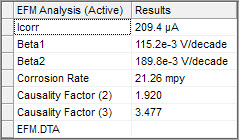
The Electrochemical Frequency Modulation Software is a non-destructive corrosion rate measurement technique. It allows for measurement of the corrosion rate without prior knowledge of the Tafel constants. In addition, the technique determines the Tafel constants and provides 2 internal validity checks.
Menu
Close
Software
Product Details
Overview
Electrochemical Frequency Modulation (EFM) software is a powerful non-destructive method for measuring the corrosion rate. It is an ideal and inexpensive companion to DC corrosion techniques software. It was developed at the University of Leuven in Belgium with support from the Electric Power Research Institute.
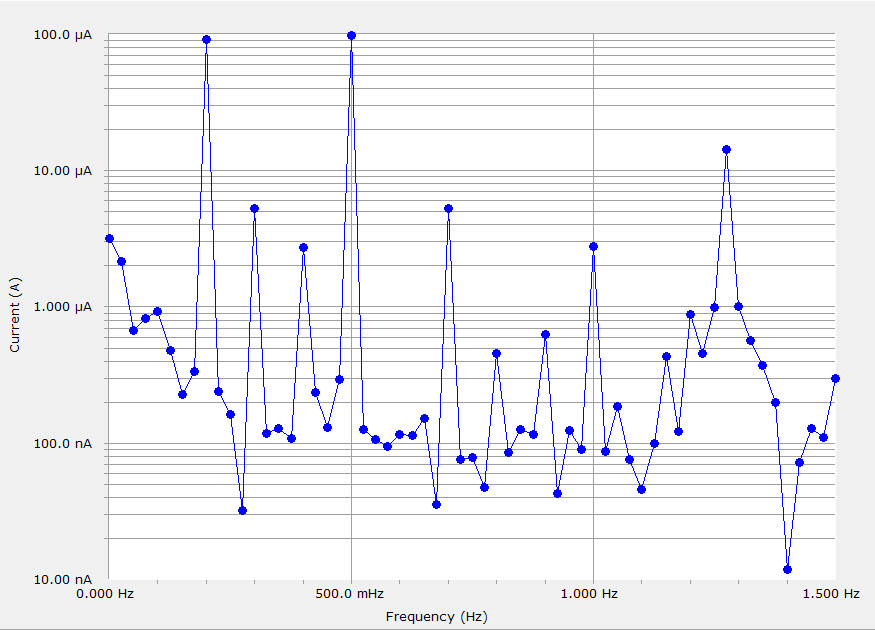
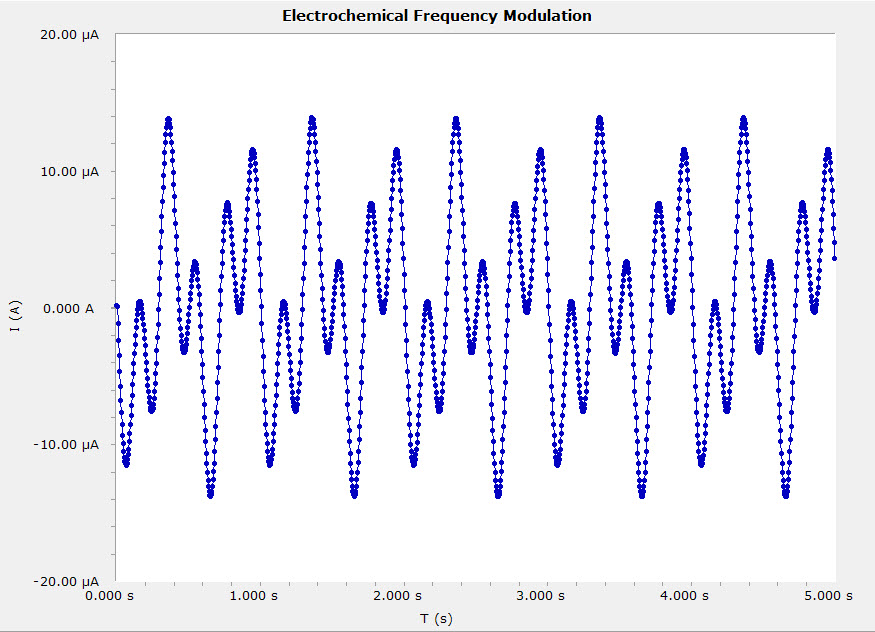
EFM is a harmonic technique that relies on the non-linear nature of the corrosion reaction to extract information about the corrosion rate and the Tafel constants. Two sinusoidal voltage waveforms are summed and applied to a corrosion sample. The resultant current response is recorded. The data are further transformed from the time domain into the frequency domain where the frequency response is analyzed to yield corrosion rate information.
The EFM Software operates within the Gamry Framework, and is available for use within the Sequence Wizard. The technique is also compatible with the ECM8 multiplexer.
System Requirements
- Gamry Reference or Interface Family Instrument or other USB-based instrument compatible with the Gamry Framework Software
- Microsoft® Windows™ 10(32-bit or 64-bit) Required, Microsoft® Windows™ 11(32-bit or 64-bit) Recommended
- 16 GB RAM Required, 32 GB RAM Recommended
Experiments
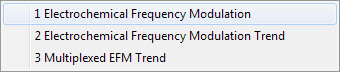
Electrochemical Frequency Modulation
The standard EFM technique which calculates a single corrosion rate.
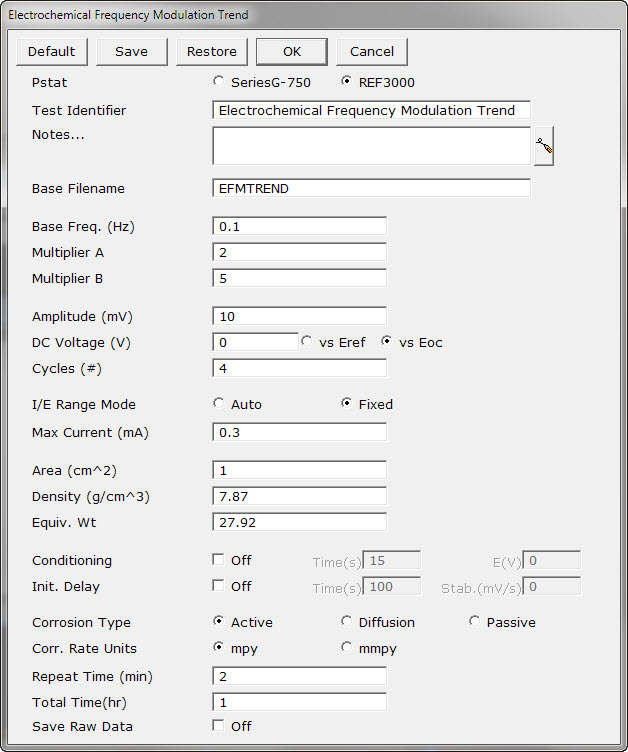
Electrochemical Frequency Modulation Trend
This experiment performs multiple EFM measurements over a period of time to build up a corrosion rate versus time trend graph.
Multiplexed EFM Trend
EFM Trend measurements, with multiplexer functionality.