Electrochemical Impedance Spectroscopy
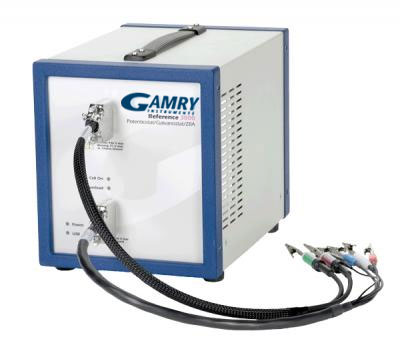
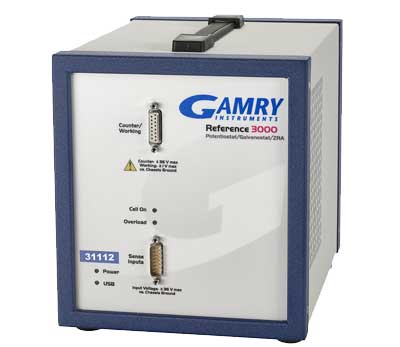
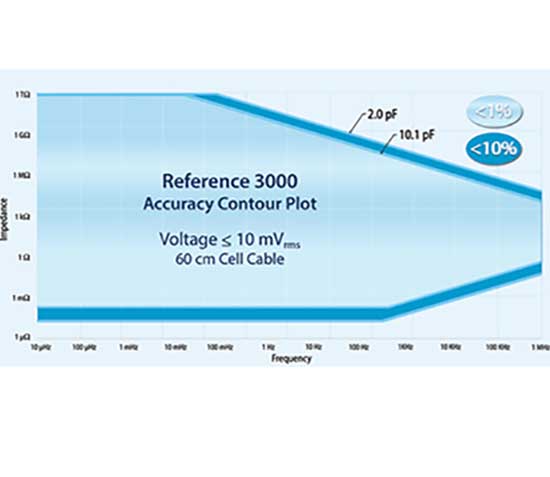
The Reference 3000 is fully equipped to perform electrochemical impedance spectroscopy up to 1 MHz. The Accuracy Contour Plot below provides a detailed look at the performance you can expect from your instrument in real-world situations. The results include the cell cable.

Options
Auxiliary Electrometer
The auxiliary electrometer is a factory installed option that adds an array of eight differential voltage inputs. Each of the eight channels can measure a ± 5 volt signal anywhere over the Reference 3000’s entire compliance voltage range. Impedance measurements up to 100 kHz can also be performed using the auxiliary electrometer.
Extended Cable Lengths
Extended length cell cables (1.5 and 3 meter) are also available for your convenience.
Auxiliary Electrometer Cables: The standard Auxiliary Electrometer cables are 90 cm. Extended length cables (1.5 and 3 meter) are available.
Below are additional details regarding the capabilities of the Reference 3000 potentiostat. Each bullet point contains a list of the type of techniques available for the instrument to run.
- Physical Electrochemistry - Techniques such as cyclic voltammetry, chronoamperometry, and chronopotentiometry and derivatives of these techniques.
- Pulse Voltammetry - Techniques such as pulse voltammetry, square wave voltammetry, and associated stripping techniques such as anodic stripping voltammetry.
- DC Corrosion - Run standard DC corrosion tests such as polarization resistance, potentiodynamic, cyclic polarization, and galvanic corrosion in addition to a number of others.
- Electrochemical Energy - Test single-cells and stacks of various batteries, fuel cells or supercapacitors. Includes charge, discharge, cyclic charge-discharge techniques, potentiostatic, galvanostatic, self-discharge, leakage rate, and read cell voltage.
- Electrochemical Signal Analyzer - Designed specifically for the acquisition and analysis of time-dependent electrochemical noise signals. Cell voltage and current are continuously monitored at rates from 0.1 Hz to 1 kHz. A full featured set of analysis tools provides powerful analysis features such as statistical analysis, detrending, impedance spectra, and histogram analysis.
- Electrochemical Frequency Modulation - A non-destructive corrosion rate measurement technique. It allows for measurement of the corrosion rate without prior knowledge of the Tafel constants. In addition, the technique determines the Tafel constants and provides 2 internal validity checks.
- Critical Pitting Temperature - controls a Gamry Potentiostat, TDC5 Temperature Controller, and associated accessories to automatically measure the Critical Pitting Temperature of a material.
- Electrochemical Noise - A more general form of electrochemical noise testing. It is also an ECM8 Multiplexer compatible electrochemical noise software package.
- Electrochemical Impedance Spectroscopy - includes experimental scripts for potentiostatic, galvanostatic and hybrid impedance spectroscopy experiments in addition to single frequency techniques like Mott-Schottky. We also have our unique power-leveling multisine technique that improves signal-to-noise across the spectrum. On the analysis side, it provides tools for fitting spectra to equivalent circuit models, Kramers-Kronig transform for data validation and a graphical model editor. Our software even includes a script for EIS simulation.
- eChemDC Toolkit - contains all of the capabilities of the eChemBasic and further extends these capabilities by adding advanced signals and data acquisition modes to simplify implementing experiments like cyclic voltammetry, pulse voltammetry, and dynamic DC corrosion techniques. Also includes more advanced stop tests, particularly useful in fast experiments.
- eChemAC - Includes full capabilities of eChemDC Toolkit plus allows electrochemical impedance spectroscopy (EIS) and EFM experiments.
Other features
- 2, 3, and 4 electrode measurements
- Electrical Isolation
- Floating instrument: use with autoclaves, mechanical stress apparatus, or pipeline probes.
- Built-In EIS
- On-board DDS to perform EIS from 10 µHz to 1 MHz.
- DSP (Digital Signal Processing) Mode
- Oversamples for improved signal-to-noise and accurate capacitance measurements.
- Current Interrupt and Positive Feedback iR Compensation
- Gamry potentiostats and their controlling software use control loop algorithms to accurately measure and correct for uncompensated resistance.
- Auxiliary I/O
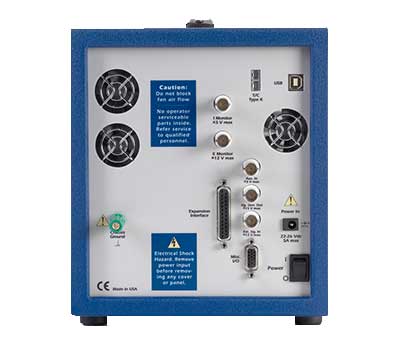
- Control additional equipment via additional I/O interfaces: external signal input, analog voltage output, analog current output, auxiliary A/D input, and digital I/O connector.
- Warranty
- Protected by 2-year factory service warranty.
Robust and precise testing of PEM fuel cells
Rating: 5.0 
Organization: Technical University of Munich
Application Area: PEM fuel cell testing
Highly customisable for many different applications
Rating: 4.7
Organization: University of Cambridge
Application Area: Electrophoretic Deposition of Nanoparticles
Easy to use and very helpful after-sales support
Rating: 4.3
Organization: The Timken Company
Application Area: Corrosion testing of metals
Great results and great papers
Rating: 5.0
Organization: University
Application Area: Battery and corrosion
Great instrument, I will keep using this for my research.
Rating: 5.0
Organization: Hainan University
Application Area: Testing PEM/AEM water electrolyzers for V-i curves, impedance, and durability.
I only buy Gamry potentiostats.
Rating: 5.0
Organization: University of Canterbury
Application Area: Electrochemistry
Stable and easy to use.
Rating: 4.0
Organization: Charles Darwin University
Application Area: Corrosion
Highly recommended for corrosion studies.
Rating: 4.7
Organization: The Timken Company
Application Area: Study corrosion of metals and degradation of coatings
Excellent results. planning to get another one to increase the number of channels.
Rating: 4.7
Organization: Botswana International University of Science and Technology
Application Area: Batteries and supercapacitor research
More practical training needed.
Rating: 4.0
Organization: Al-Azhar University, Faculty of Science
Application Area: Electrochemistry, corrosion, batteries, biochemistry
Great observations aren't possible without this machine.
Rating: 4.7
Organization: Rajiv Gandhi University, Itanagar
Application Area: Biosensor, supercapacitor
Works well, could be improved with data safety and connectivity.
Rating: 5.0
Organization: TU Berlin
Application Area: Water electrolysis research
Great system, great results and the best for the electrochemical analysis of materials.
Rating: 5.0
Organization: Max Planck Institute for chemical energy conversion
Application Area: Electrochemical performance analysis of fuel cell catalysts
Everyone should buy from Gamry, Andrew is the best in support team
Rating: 5.0
Organization: Pittsburg State University
Application Area: Electrochemistry
A very nice instrument for pretty much every electrochemical application.
Rating: 5.0
Organization: Hydro Precision Tubing
Application Area: Plating and corrosion testing of aluminium alloys
Good product! Still have lots of functions to explore.
Rating: 4.7
Organization: Clemson University
Application Area: Solid oxide fuel cells and electrolysis cells testing
Have been using Ref. 3000 and 1010e for 5 years. No complaints since.
Rating: 5.0
Organization: Oregon State University
Application Area: Corrosion of ferrous and non ferrous alloys
I would always prefer gamry for my research projects.
Rating: 3.3
Organization: King fahd university of petroleum and minerals
Application Area: Passivation of duplex stainless steel alloys for different applications
Great all-rounder for the electrochemistry lab
Rating: 5.0
Organization: DWI Leibniz Institute for Interactive Materials
Application Area: Analyzing ion exchange membranes and electrochemical cells
Worth every penny
Rating: 5.0
Organization: Qingdao University
Application Area: Electrochemical measurements
Easy to use.
Rating: 4.0
Organization: The Timken Company
Application Area: Corrosion testing


 Powered by Bioz